Why Did My Credit Score Drop? Common Causes
A lower number can mean your report changed, or simply that you are looking at a different scoring model, bureau, or date. Confirm the comparison first, then trace the underlying report.
Illustrative example: A banking app shows 714 on Monday. An auto lender says 681 on Tuesday. The app identifies its number as a VantageScore 3.0 based on TransUnion data. The lender used a FICO Auto Score based on Experian data.
That is not proof that the same score fell 33 points. It is a comparison between two scoring formulas and two credit-report sources. The underlying data may differ too.
A credit score is calculated from a credit-report snapshot. It is not a permanent number stored inside the report. When the model, version, report source, or data changes, the result can change. The size of the point difference does not reliably identify the cause because the same event can affect two credit files differently.
This example is illustrative. It is not a client result or a prediction of how many points any event will add or subtract.
First: confirm you are comparing the same score
Before looking for damage, collect the identifying details for both numbers.
| Detail | What to record | Why it matters |
|---|---|---|
| Model and version | FICO Score 8, a FICO Auto Score, VantageScore 3.0, or whatever the provider names | Different formulas can produce different results from the same report |
| Credit-report source | Equifax, Experian, or TransUnion | The three files may not contain identical information |
| Score date | The date each score was calculated | A balance or account status may have updated between the two dates |
| Score range | The minimum and maximum shown by the provider | Not every scoring model uses the same range |
| Provider | The bank, app, lender, or monitoring service | It tells you where to ask when the model details are unclear |
The provider name alone is not enough. A bank app and a lender can show different scores even when both numbers are legitimate. Read how credit scores work and why you have more than one before treating every difference as a decline.
When the model and bureau match, compare the dates. If the later score is lower, move to the report data. If the model or bureau does not match, you have not yet established that one score dropped.
A reported balance or credit limit changed
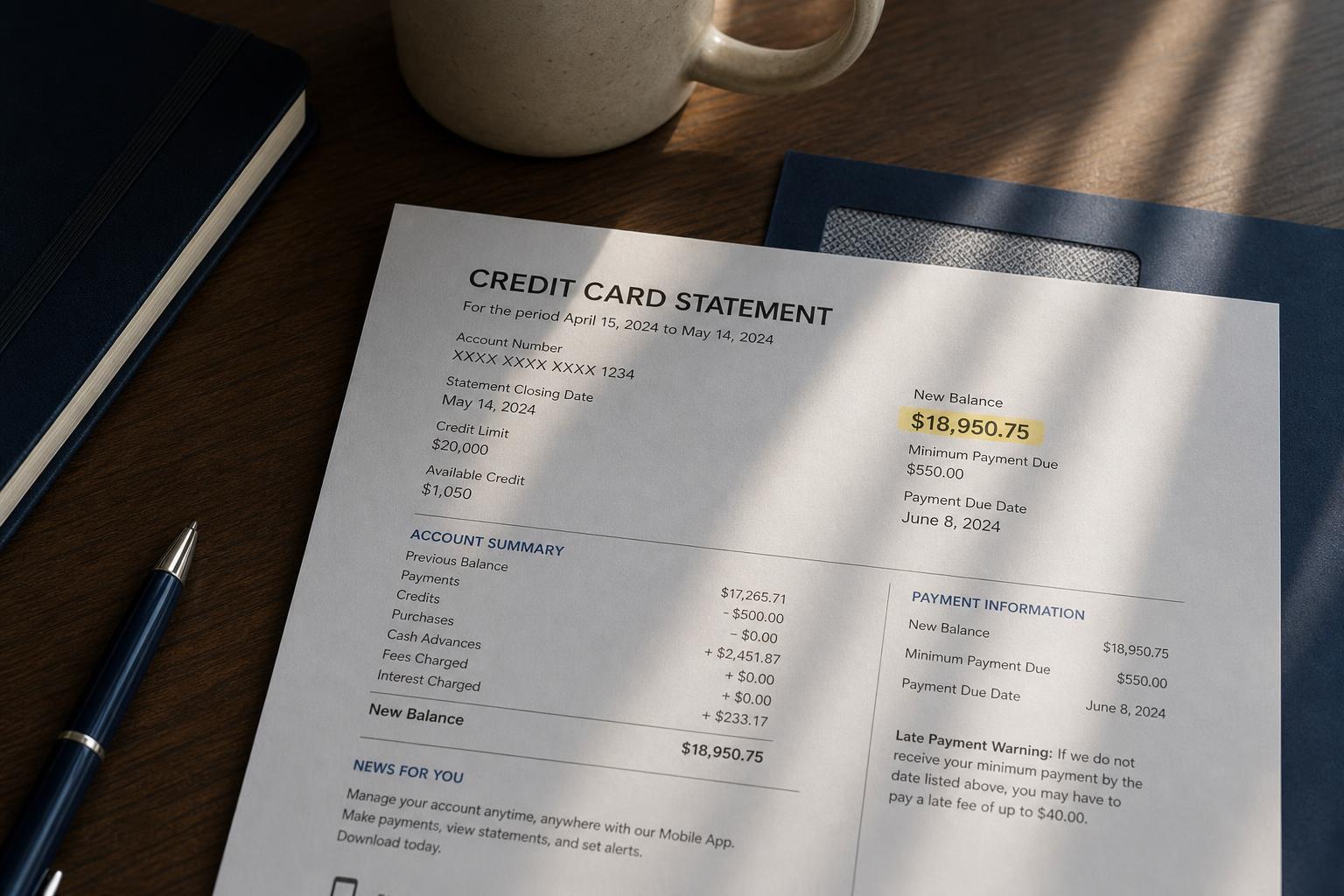
Credit-card balances are one of the fastest-moving fields on a report. Scoring models can evaluate both the balance-to-limit ratio on an individual card and the ratio across all revolving accounts.
Suppose a card has a $5,000 limit and the report shows a $3,800 balance:
$3,800 ÷ $5,000 = 76% utilization on that card
Now suppose you paid the $3,800 after the account’s last reported update, but before the payment due date. Your card account can show a current balance of $0 while the credit report still shows $3,800. That is a reporting-timing difference, not a late payment.
Check three fields together on each bureau’s report:
- the reported balance;
- the reported credit limit;
- the date the creditor last updated the account.
A lower limit can raise the ratio even when the balance did not change. An incorrect balance or limit may be disputable. An accurate balance that was furnished before your payment is not an error merely because it is no longer current.
After a creditor reports a lower balance, a score may respond. The amount and timing are not guaranteed because scoring models and the rest of the file differ. For the underlying math, see Credit Utilization and the “30% Rule” Myth.
A late payment, collection, or other negative mark appeared
Look at the account history, not only the alert headline. A payment can incur a contractual late fee before it reaches the credit-report category commonly shown as 30 days past due. If a report now shows a 30-, 60-, or 90-day late status, verify the month, amount due, payment date, and account number against your records.
A collection, charge-off, repossession, or bankruptcy can also change a score. Its effect depends on the scoring model and the rest of the file, so there is no reliable “this item equals this many points” table.
If a collection appears next to the original creditor’s account, do not assume the debt has automatically been counted twice. Compare the balances and statuses. The original account may report the history while a collector reports the current balance. What matters is whether each field is complete and accurate.
Bringing an account current does not erase an accurate prior late payment. Paying or settling a collection does not guarantee deletion or a particular score change. Accurate, current negative information generally cannot be removed solely because it is harmful. Information that is inaccurate, incomplete, duplicated, or not yours may be disputable.
For the reporting timelines, see How Long Do Negative Items Stay on Your Credit Report?
A hard inquiry or new account was added
A credit application and a newly opened account are two separate report events.
The hard inquiry can appear when a lender accesses the report for an application. If the account is approved and opened, the new tradeline may appear later. That account can change the age of the file, the number of recently opened accounts, the available credit, and the credit mix. The net effect varies.
Review the inquiry section and the account section independently. A legitimate inquiry from an application you made is not an error just because the score later moved. Several mortgage, auto-loan, or student-loan inquiries made while rate shopping may receive special treatment under a scoring model, but the window and treatment vary. The details are in Soft vs. Hard Credit Inquiries.
Checking your own credit report does not lower your score. Pulling the reports is part of the diagnosis, not another cause of damage.
A card closed, a limit fell, or a loan was paid off
Closing a credit card can change utilization without any new spending.
Illustrative calculation:
Before closure: $2,000 in card balances ÷ $10,000 in total limits = 20%
After an unused $5,000-limit card closes: $2,000 ÷ $5,000 = 40%
The balance stayed at $2,000. The denominator was cut in half.
A closed card does not necessarily vanish from the report or stop contributing to account-age calculations immediately. The more immediate score change is often the lost credit limit. An issuer-initiated limit reduction can create the same utilization problem without closing the account.
Paying off a loan can produce a different surprise. Some FICO models can score the file lower after the last active installment loan is paid off, even though the debt was repaid as agreed. That does not make the payoff a financial mistake. Do not keep a loan open, take out a new loan, or pay interest solely to preserve score points.
An error, mixed file, or identity theft
An unexplained decline deserves a line-by-line report review. Look for:
- a late payment you made on time;
- a balance, limit, or account status that is wrong;
- the same debt reported twice in a way that is inaccurate;
- an account belonging to someone with a similar name or identifier;
- a hard inquiry or account you do not recognize;
- an address, employer, or personal identifier that suggests your file was mixed with someone else’s.
Dispute a specific inaccuracy with the credit reporting company and the business that furnished the information. State what is wrong, what it should say, and attach copies of the documents that support your position. Keep the complete submission and proof of delivery. The step-by-step process is in How to Dispute an Error on Your Credit Report.
An unfamiliar account can be identity theft rather than an ordinary reporting mistake. Contact the creditor using independently verified contact information, consider placing a free credit freeze with each nationwide bureau, and use IdentityTheft.gov to build a recovery plan. This comparison explains fraud alerts, credit freezes, and credit locks.
Do not dispute accurate information simply to see whether it disappears. The dispute process exists to correct inaccurate or incomplete reporting.
How to pinpoint what changed
Use the score as an alert. Use the reports to identify the event.
1. Save the score details
Record the score, model and version, bureau, date, provider, and listed reason codes. A screenshot is useful when the service does not retain history.
2. Pull all three reports
Request the reports through AnnualCreditReport.com. Free online reports are available weekly from Equifax, Experian, and TransUnion. Checking them yourself does not affect your score.
One bureau may show a change before another, or a creditor may furnish to fewer than all three. Review each report separately.
3. Compare the data since the earlier score date
Focus on fields that can change the calculation:
- revolving balances and limits;
- payment status and late-payment history;
- newly opened or closed accounts;
- hard inquiries;
- collection, charge-off, repossession, or bankruptcy information;
- account dates and last-updated dates;
- unfamiliar personal information or accounts.
Do not use the alert date as proof of when the underlying event happened. Verify the dates inside the account record.
4. Read reason codes as a snapshot, not a change log
A score provider may list factors such as high revolving balances, recent delinquency, short account history, or too many inquiries. Those codes identify factors having the greatest negative influence on that score at that time. They do not identify every report change, and one event can produce more than one reason code.
5. Match the finding to the action
| What you find | What it establishes | Next move |
|---|---|---|
| Different model, version, or bureau | The two numbers are not a clean before-and-after comparison | Find comparable score details or focus on the underlying reports |
| Higher balance or lower limit | Utilization changed | Verify the reported fields and update date; dispute only if inaccurate |
| New late payment or collection | Negative information was added or updated | Verify the dates and status; contact the creditor or collector; dispute any error |
| New hard inquiry or account | An application or new-credit event occurred | Confirm that you authorized it and review the account terms |
| Closed card or paid-off loan | The structure of the file changed | Review utilization and active-account mix; do not borrow merely to chase points |
| Unknown account, inquiry, or personal data | Possible error, mixed file, or identity theft | Freeze if appropriate, contact the source, document the issue, and dispute or report it |
If the same model and bureau produced a lower score but the report appears unchanged, ask the score provider whether its model version or data source changed. Also compare the account update dates. Time itself changes account age, inquiry age, and the age of negative information, even when no new account appears.
Key takeaways
- A 714 app score and a 681 lender score do not establish a 33-point drop unless the model and bureau match and both score dates are known.
- A report can show $3,800 on a $5,000 card, or 76% utilization, after you paid if the payment posted after the last furnished update.
- Closing an unused $5,000 limit can turn $2,000 ÷ $10,000 (20%) into $2,000 ÷ $5,000 (40%) without new spending.
- Paying off the last active installment loan can lower some FICO scores; keeping debt or paying interest solely for score points is not the answer.
- Reason codes show what is weighing on a score now. The account data and update dates show what actually changed.
Can’t figure out what changed?
A free 15-minute review compares what’s reporting across all three bureaus and helps pinpoint what moved your score — and whether anything shouldn’t be there.
Free · about 15 minutes · no credit card · no obligation.
Sources: Consumer Financial Protection Bureau (CFPB) — understand your credit score, closing a credit card, free credit reports, and credit-report disputes; FICO — paying off an installment loan and credit-score reason codes; VantageScore — why scores change; IdentityTheft.gov. Scoring varies by model, version, bureau, and individual file. This is general education, not legal or financial advice.