Soft vs. Hard Inquiries: What Actually Affects Your Score
A soft inquiry cannot lower your score. A hard inquiry can. The label on an offer does not tell you which one will happen, and several loan pulls can still be one scoring event.
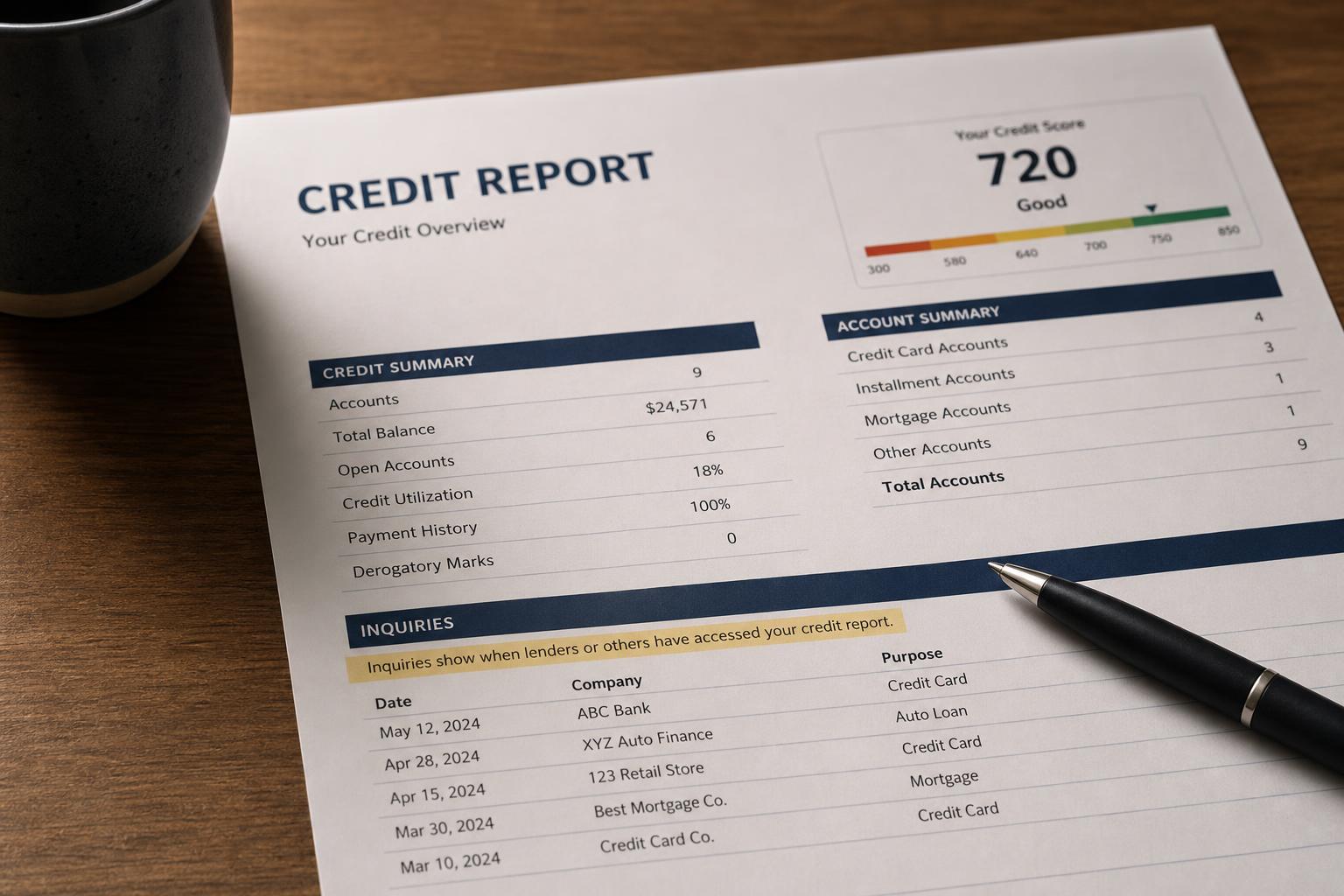
Illustrative example: You complete one financing application at an auto dealership on Saturday. By Monday, one of your credit reports lists five hard inquiries from lender names you do not recognize.
That does not necessarily mean you applied for five separate cars or took five separate score hits. The Consumer Financial Protection Bureau says dealers commonly send a financing application to roughly five potential lenders. Every lender inquiry can remain visible as its own line, while an eligible scoring model may group same-type auto-loan inquiries made inside its rate-shopping window.
The details matter. A credit-card inquiry made the same day would be separate from the auto-loan cluster. An auto inquiry 20 days later may fit a newer 45-day FICO window but fall outside an older 14-day version. The number of lines on the report is not always the number of inquiry events used in the score calculation.
This example is illustrative. It is not a client story, a score prediction, or a guarantee that a particular model will group the inquiries.
Start with why the report was accessed
An inquiry is a record of access to a credit file. It is not a loan, an account, or a debt. The hard-or-soft classification describes why the file was accessed and how scoring models treat that access.
The same company can make both kinds of inquiry. A card issuer can review an existing account with a soft inquiry, then make a hard inquiry when the customer applies for a different card. A mortgage company can use a soft inquiry for an early rate-check tool and a hard inquiry later in the preapproval or application process.
When you review the inquiries section, ask four questions:
- What transaction or account review was happening on that date?
- Did I submit a formal application, or was I only checking possible terms?
- Did a broker, dealer, or marketplace send my information to more than one lender?
- Which bureau was accessed?
A lender may pull Equifax, Experian, TransUnion, or more than one. An inquiry on one report does not have to appear on the other two. Start with the exact report and date instead of assuming all three files contain the same history.
Soft inquiry: no score effect does not mean no consequence
Soft inquiries do not affect credit scores. Checking your own reports or scores is a soft inquiry, and the CFPB says the nationwide bureaus make free online reports available weekly through AnnualCreditReport.com. Monitoring the file is not another source of score damage.
Other common soft inquiries include:
- an existing creditor reviewing an account;
- a creditor or insurer screening a file for a prescreened offer;
- an employer obtaining a credit-related background report after receiving the required written permission;
- some prequalification and rate-check tools.
Soft inquiries are generally shown on the consumer copy of the report and are not included when another company purchases the report. Ten soft inquiries do not become a hard inquiry, and the number of soft inquiries does not create a scoring penalty.
But no score effect does not mean no real-world effect.
An existing card issuer may use a soft account review and later lower the credit limit. The soft inquiry did not lower the score, but the lower limit could raise utilization and affect the next score calculation. An employer may use information in a background report when making a permitted employment decision. A prescreened lender may decide not to extend an offer.
Separate the inquiry from the action taken after it. When a score changes after an account review, compare the reported balance, limit, status, and update date rather than blaming the soft pull. The diagnostic process is covered in Why Did My Credit Score Drop?
Hard inquiry: an application record, not a fixed point loss
A hard inquiry usually appears when a lender checks a report in connection with an application for new credit. Credit-card, mortgage, auto-loan, and personal-loan applications are common examples. A requested credit-limit increase can also involve a hard inquiry, depending on the issuer.
A hard inquiry can affect a score, but it does not have one universal point value. FICO says one additional hard inquiry costs less than five points for most people. Some files may move less, more, or not at all. The model version, bureau data, recent applications, and the rest of the file all matter.
Three separate events are easy to confuse:
| Event | What can appear on the report | Possible score effect |
|---|---|---|
| A lender checks the file for an application | A hard inquiry | The inquiry may affect the score |
| The application is denied | No separate “denial” item | The denial itself is not another scoring event |
| The application is approved and the account opens | A new account, balance, and payment history may appear later | The new account can affect age, mix, balances, and recent-credit factors |
An application can leave a hard inquiry even when no account is opened. Conversely, a score change after approval may reflect the new account or balance as well as the earlier inquiry.
That is why “the inquiry dropped me 18 points” is usually not something the report alone can prove. To isolate the cause, compare the same score model, bureau, and dates, then inspect both the inquiry section and the account section.
Ask before you let a company check
Marketing labels do not reliably tell you how a credit check will be coded. “Prequalified,” “preapproved,” and “check your rate” are not standardized promises that every step will use a soft inquiry.
Use the disclosure and ask a direct question before continuing:
Will this step create a hard inquiry on any of my Equifax, Experian, or TransUnion reports? If not now, at what later step would a hard inquiry occur?
The answer depends on the transaction.
| Situation | What usually happens | What to confirm |
|---|---|---|
| You request your own report or score | No hard inquiry; no score effect | Use the provider’s official access process |
| A creditor reviews an account you already have | Soft inquiry | Whether a separate request, such as a limit increase, changes the process |
| You receive a prescreened credit or insurance offer | Soft inquiry | Whether accepting or formally applying triggers a hard inquiry |
| You use a card or personal-loan “check my rate” tool | Often soft at the initial step, but the label is not enough | Read the disclosure immediately before submitting |
| You request a mortgage preapproval | A credit check may occur and can be hard | Which bureau or bureaus, and whether another pull occurs before closing |
| You apply for a new credit card, auto loan, mortgage, or personal loan | Usually hard | Whether an intermediary will send the application to multiple lenders |
| You request a credit-limit increase | Can be hard or soft, depending on the issuer and process | Whether you can cancel before a hard inquiry is made |
| You apply for an apartment, utility, or phone service | The process can use a hard inquiry, a soft inquiry, or a specialty report | Ask the landlord or provider which company and report it uses |
| An employer orders a consumer report | The credit inquiry is soft; written permission is generally required under the FCRA | What reporting company will supply the background report |
A lender cannot pull a report merely because you asked a general question about rates. Once you submit application information or request a formal credit decision, the process may change.
Do not assume a separate document labeled “hard-pull authorization” is required in every situation. The Fair Credit Reporting Act requires a permissible purpose for access, but the consent rules are not identical across credit, housing, insurance, and employment. Employment reports are the clearest written-consent case. For ordinary credit, the application itself can establish the transaction that permits the lender to review the file.

Rate shopping: why five lines may count as one
Rate-shopping treatment exists because several applications can represent one intended loan. The consumer is comparing terms, not trying to open five mortgages or buy five cars.
For FICO scoring, the special treatment applies to inquiries coded as:
- mortgage;
- auto loan;
- student loan.
FICO describes two layers of protection:
- Eligible rate-shopping inquiries made during the 30 days before a FICO score is calculated are ignored in that calculation.
- After that initial period, multiple eligible inquiries inside the model’s shopping window are counted as one inquiry for scoring.
Older FICO versions use a 14-day shopping window. Newer versions use 45 days. VantageScore’s published consumer guidance uses a 14-day rolling window for mortgage and auto inquiries. Because you usually do not know which score version a future lender will use, completing the comparison inside 14 days is the conservative practical target when feasible.
Illustrative inquiry timeline
| Day | Report event | Possible scoring treatment |
|---|---|---|
| 1 | Auto lender A checks the report | First inquiry in the auto-loan cluster |
| 5 | Auto lender B checks the report | Within both the 14-day and 45-day windows |
| 5 | A credit-card issuer checks the report | Separate from the auto-loan cluster under FICO’s rate-shopping treatment |
| 12 | Auto lender C checks the report | Still within both windows |
| 20 | Auto lender D checks the report | Within a newer 45-day FICO window; may fall outside an older 14-day window relative to the first pull |
All five inquiry lines can remain visible. Grouping changes the score calculation; it does not merge or delete the entries on the report. A lender can also see the individual hard inquiries and apply its own underwriting rules even when the score model groups them.
Do not assume the same protection applies to a batch of credit-card or personal-loan applications. FICO’s published special-treatment categories are mortgage, auto, and student-loan inquiries. Shopping for two different loan types, such as a mortgage and an auto loan, creates separate inquiry groups.
The dealership scenario at the start is common enough to plan for. Ask the dealer whether it will send the application to multiple lenders and request the offers it received. For the financing process beyond the inquiries, see How to Get a Car Loan With Bad Credit.
How long inquiries remain and who can see them
Report retention and score impact are different clocks.
| Inquiry type | What appears on the report | Direct score treatment |
|---|---|---|
| Hard inquiry | Can remain for up to 24 months and can be seen by companies that obtain the report | FICO considers hard inquiries from the previous 12 months; other models may use different periods |
| Soft inquiry | May appear on the consumer copy; CFPB says it is not shown when others purchase the report | No direct effect on credit scores |
The inquiry can therefore remain visible after it stops affecting a FICO score. Its presence at month 18 does not mean it is still costing the same points it may have cost when new.
A soft inquiry still deserves a quick review when the name or purpose makes no sense. It cannot lower the score, but the inquiries section is also an access history. An unexpected employer, insurer, creditor, or service provider may warrant a call even when the inquiry is soft.
Pull all three reports when you are auditing access. A lender may have checked only one bureau, and a monitoring service that watches one file will not necessarily alert you to activity on the other two. Checking the reports yourself remains score-neutral.
What to do with an inquiry you do not recognize
An unfamiliar business name is a reason to investigate, not immediate proof of fraud. The report may show a lender’s legal name instead of the dealership, broker, card brand, or marketplace you remember.
Work through the inquiry in this order.
1. Record the exact entry
Save the bureau, inquiry date, company name, address, phone number, and whether the report places it in the hard or soft section. Take a screenshot or save the report page.
2. Compare it with transactions around that date
Check credit applications, dealership paperwork, mortgage or rental forms, emails, text messages, and rate-shopping tools. One dealer or broker may have sent the same application to several lenders.
An accurate inquiry tied to a transaction you initiated is not inaccurate merely because:
- the lender denied the application;
- no account was opened;
- the report uses an unfamiliar corporate name;
- the inquiry affected a score.
For a rental application, the screening process may create an inquiry even though the landlord’s later decision does not create a second one. See Does an Apartment Denial Hurt Your Credit?
3. Ask the listed company to identify the purpose
Use independently verified contact information or the contact details on the credit report. A useful written request is:
Your company appears as a hard inquiry on my [bureau] credit report dated [date]. Please identify the application, transaction, or other permissible purpose for the access, including any business or broker name through which the request was submitted.
Do not send a Social Security number or identity documents to an unverified email address or caller.
4. Look for a new account or changed personal information
An inquiry may be the first visible sign of identity theft. Review all three reports for an account you did not open, an address you do not recognize, or other unfamiliar activity.
5. Act quickly if the transaction is not yours
Place a free security freeze separately with Equifax, Experian, and TransUnion. A freeze can block prospective creditors from accessing the files until you lift it. You can also place an initial fraud alert and use IdentityTheft.gov to create an identity-theft report and recovery plan.
A freeze does not lower a credit score. It also does not fix an inquiry or stop misuse of an account that is already open, so contact any affected creditor directly.
6. Dispute inaccurate information with evidence
If the company cannot identify a valid transaction or the inquiry belongs to someone else, dispute the specific entry with the credit reporting company and the business listed as having accessed the report. Include the date, company name, reason it is inaccurate, and copies of supporting records. Keep the complete submission and proof of delivery.
Do not file blanket disputes against every accurate inquiry in hopes that some disappear. The dispute process is for inaccurate or incomplete information. The full procedure is in How to Dispute an Error on Your Credit Report.
If the companies do not resolve a documented problem, the CFPB accepts credit-reporting complaints.
Key takeaways
- One dealership application can produce roughly five lender inquiries. The report may list every line even when an eligible score model treats the auto-loan cluster as one event.
- “Prequalified,” “preapproved,” and “check your rate” do not by themselves promise a soft pull. Ask which bureau will be checked, at what step, and whether the application will be sent elsewhere.
- A soft inquiry cannot lower a score, but an action taken after a soft account review can. A later limit cut, for example, may raise utilization.
- Older FICO models use a 14-day rate-shopping window and newer versions use 45 days; eligible inquiries made during the 30 days before scoring receive additional FICO treatment.
- A hard inquiry can remain visible for 24 months while FICO considers only the previous 12. Investigate an unfamiliar name before disputing it, and freeze all three files when identity theft is plausible.
Want to see your inquiries — and everything else on file?
A free 15-minute review walks through what’s on your credit report, including recent inquiries, so nothing on it catches you by surprise at your next application.
Free · about 15 minutes · no credit card · no obligation.
Sources
- Consumer Financial Protection Bureau: What Is a Credit Inquiry?
- Consumer Financial Protection Bureau: What Kind of Credit Inquiry Has No Effect on My Credit Score?
- Consumer Financial Protection Bureau: When Will a Lender Run or Obtain a Copy of My Credit Report?
- Consumer Financial Protection Bureau: Who Can Request to See My Credit Report?
- Consumer Financial Protection Bureau: Does Requesting My Credit Report Hurt My Credit Score?
- Consumer Financial Protection Bureau: What Should I Know Before I Shop for an Auto Loan?
- FICO: How to Rate Shop and Minimize the Impact to Your FICO Scores
- VantageScore: Thinking About Applying for a Loan? Shop Around to Find the Best Offer
- Consumer Financial Protection Bureau: Credit Freezes
- IdentityTheft.gov
Scoring treatment varies by model, version, bureau, inquiry coding, and individual credit file. Laws and screening practices can also vary by transaction and jurisdiction. This article is general education, not legal or financial advice. It does not guarantee a particular score effect, approval decision, or removal of accurate information.