How to Get a Car Loan With Bad Credit (Without Getting Ripped Off)
Bad credit changes the offers available to you. It does not change the math. Bring an outside financing benchmark, compare the full cost of each loan, and keep the car price separate from the payment.
One pattern MSI sees often is a buyer who has already visited three lots and heard roughly the same high rate each time. By the third quote, the number starts to feel fixed. But three dealer quotes are not the same as three independent lender offers.
Now add an illustrative payment target: “I have to stay under $425 a month.” An $18,000 loan at 18.00% APR comes to about $411 a month over 72 months. The same loan over 48 months is about $529. The target was met by adding two years, not by improving the deal.
Those extra two years add about $4,179 in interest. Approval is only the first question. The useful questions are: What car price did you agree to? How much are you financing? What is the APR? How long will you be paying? What is the total of payments? You need those answers in writing before you sign.
Start with what the lender will actually see
Your credit score matters, but it does not set an auto-loan rate by itself. Lenders can also weigh your credit history, income, debts, down payment, loan amount, term, and the vehicle. A score from a consumer app may not be the same score the lender uses.
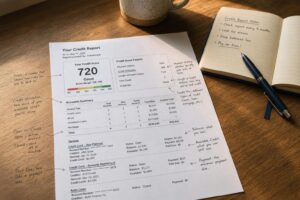
Review your credit reports before you apply. Look for accounts that are not yours, balances that are wrong, duplicate debts, or payments reported late when they were on time. Information that is inaccurate or incomplete may be disputable. Accurate, current negative information cannot simply be removed.
If you are deciding whether to apply now or wait, see how auto-loan credit tiers work. Treat the tier as a planning range, not a promised rate.
Also decide your maximum amount financed before you pick a vehicle. A monthly car payment is only one ownership cost. Insurance, registration, fuel, maintenance, and repairs still have to fit after the loan payment clears.
Separate the car price, trade-in, and financing
A dealer can move money between three parts of the transaction:
- the vehicle price;
- the trade-in allowance and payoff;
- the loan.
Negotiate them separately. Ask for a written out-the-door price that includes the vehicle, taxes, and dealer fees before discussing a monthly payment. If you have a trade-in, get its current payoff amount and a separate estimate of its value. When the payoff is higher than the trade-in value, the difference is negative equity. Rolling that balance into the next loan increases what you borrow and makes the new deal more expensive.
A large trade-in allowance does not help if the vehicle price rises by the same amount. A low monthly payment does not help if it comes from a longer term or a larger amount financed. Keeping the three numbers separate makes the tradeoffs visible.
Get an outside financing offer before the dealership
Get two or three comparable offers before you shop for the car. A bank, credit union, or finance company can give you a direct-lending benchmark. Use the same approximate loan amount and term when possible; a 48-month offer and a 72-month offer are not clean comparisons.
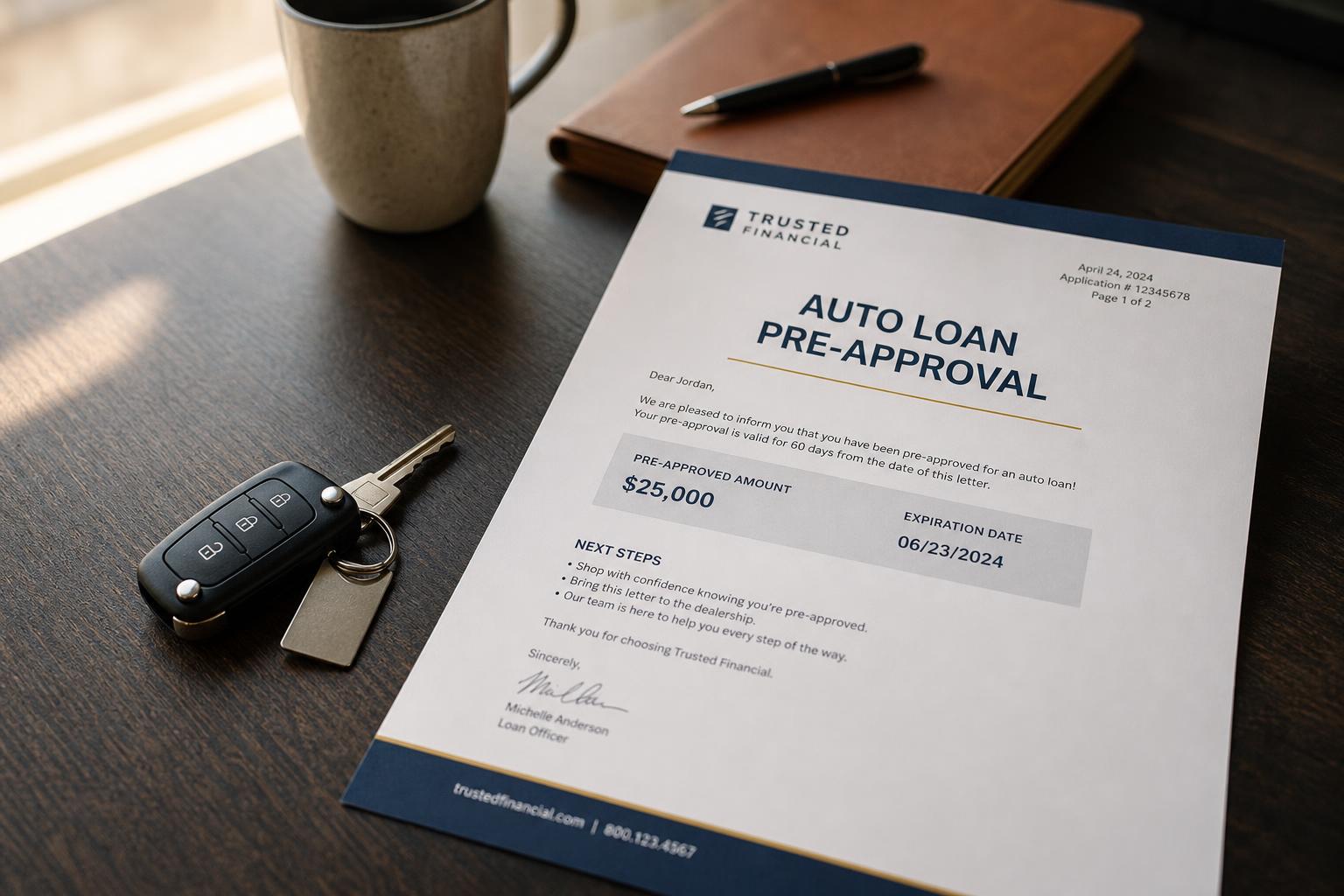
A prequalification or preapproval is a benchmark, not a guarantee. Ask whether the lender will use a soft inquiry or a hard inquiry, what documents are still required, how long the offer lasts, and whether the vehicle’s age or mileage can change the terms. If you make formal applications, keep them close together. Depending on the scoring model, auto-loan inquiries made within a 14- to 45-day window are generally treated as one for scoring.
Bring the best written offer to the dealer. Dealer-arranged financing can still win. The dealer may have access to a lender or program you did not find yourself. But make it beat your benchmark on the actual terms, not on a verbal promise or a lower payment created by adding months.
The lender may quote the dealer a buy rate, and the contract rate offered to you may be higher. The difference can compensate the dealer. The rate is negotiable, so ask plainly: “Is this the lowest APR available for this amount and term?”
See what the term does to the bill
Here is the arithmetic the monthly-payment conversation leaves out.
Illustrative loan comparison
Assumptions: $18,000 amount financed, fixed 18.00% APR, monthly payments made on schedule, and no fees, add-ons, late charges, or prepayment penalty. Figures are illustrative; displayed payments are rounded to cents.
| Term | Monthly payment | Total of payments | Total interest |
|---|---|---|---|
| 48 months | $528.75 | $25,380.00 | $7,380.00 |
| 72 months | $410.54 | $29,558.90 | $11,558.90 |
The 72-month option lowers the payment by $118.21 a month and adds $4,178.90 in interest.
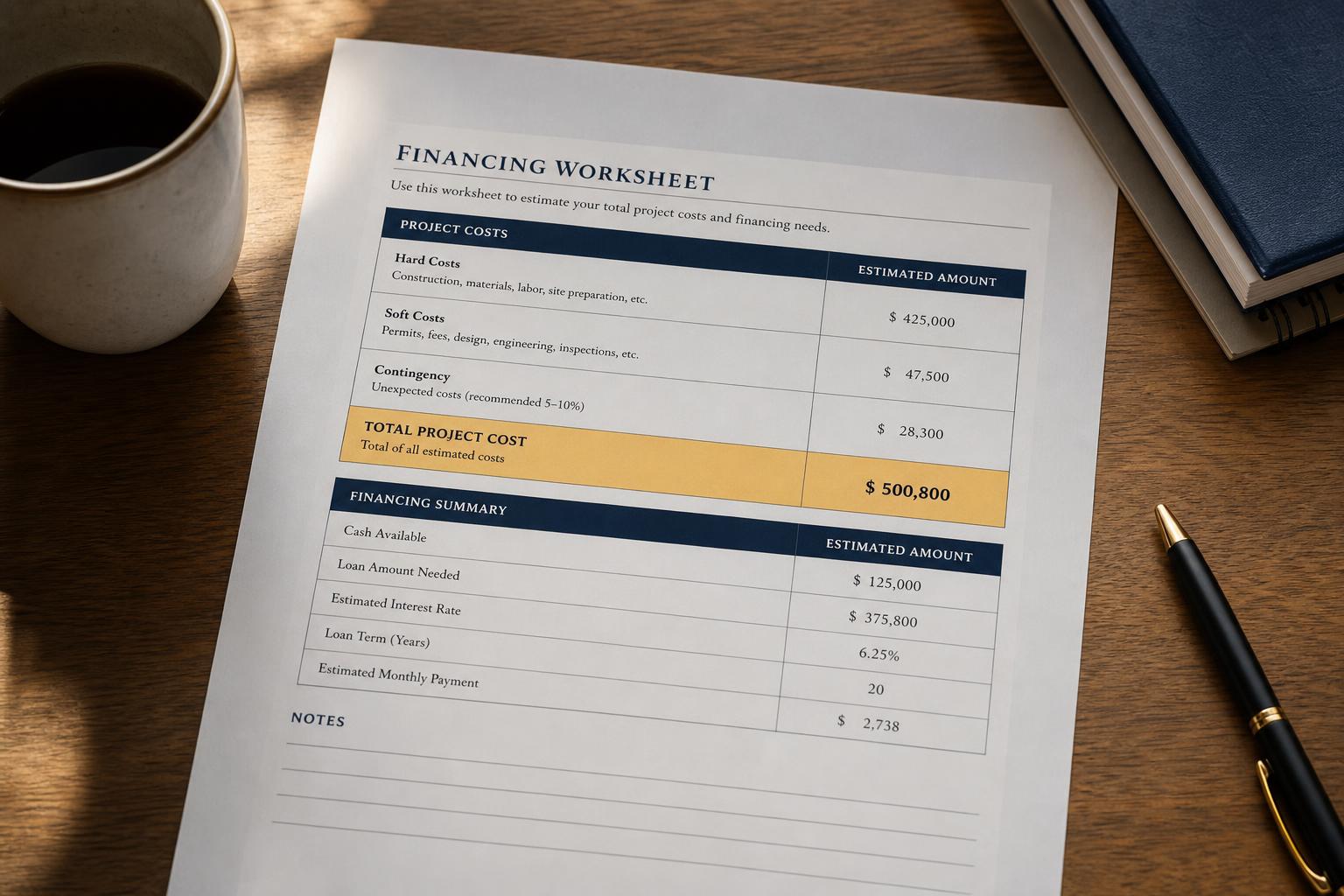
The longer loan is not secretly cheaper. It is the same $18,000 principal rented for two extra years. It can also leave you owing more than the car is worth for longer, which matters if the car is totaled, needs major repairs, or has to be sold before the loan is paid off.
If the shorter payment does not fit, the safer answer may be a less expensive vehicle, a down payment that does not drain the money needed for bills and emergencies, or more time before buying. A shorter term is useful only when the payment is sustainable.
Read the disclosure, not the sales worksheet
Before you sign, request the completed Truth in Lending disclosure and compare these lines with your outside offer:
| Line | What it tells you |
|---|---|
| APR | The yearly cost of credit, including the interest rate and certain required fees |
| Finance charge | The dollar cost of interest and certain fees over the scheduled loan |
| Amount financed | How much you are borrowing |
| Total of payments | What the scheduled loan payments add up to |
| Payment schedule | How many payments you owe and the amount of each one |
Then use the itemization of amount financed to trace the contract. Every line for the vehicle, taxes, fees, old-loan balance, add-ons, cash down, and trade-in credit should correspond to something you agreed to. Stop and ask for a line-by-line explanation when it does not.
Service contracts, GAP products, credit insurance, wheel coverage, theft products, and other add-ons can increase both the balance and the interest you pay. Some may be useful in a particular situation. None should appear because the conversation stayed focused on the monthly payment. Get each price in writing, ask whether it is optional, and remove anything you did not choose.
Do not sign a blank or partly completed form. Make sure the purchase and financing are final, all numbers match the deal you accepted, and you have a copy of every signed document before you leave with the car.
Treat “special finance” as a label, not an answer
“Special finance” does not tell you whether a loan is competitive. The written APR, amount financed, term, finance charge, total of payments, and vehicle price do.
The same rule applies to “no credit check” and buy-here-pay-here financing. These dealers typically make the loan in-house, and the rates tend to be higher than financing from banks or credit unions. Some report late payments without reporting the on-time payments that a buyer expected would help build credit.
Before using a buy-here-pay-here lot, ask for written answers to four questions:
- Will every on-time payment be reported? To which credit bureaus?
- Is the vehicle sold as-is, or is there a warranty?
- What counts as late, and when can repossession or a starter-interrupt device be used?
- What is the total of payments, and how much must be paid before the loan starts?
Read No Credit Check Car Lots: How They Work and What They Really Cost before treating easy approval as the only available route.
Refinance later only when the remaining math improves
You may be able to refinance later, but do not sign today on the assumption that a cheaper loan will appear next year. Approval and terms are not guaranteed; they will depend on your credit, income, vehicle, loan balance, and lender requirements at that time.
Compare the current payoff amount with the new amount financed, APR, fees, and number of payments left. Check the original contract for a prepayment penalty. A lower payment created by restarting the clock can increase what you pay from today forward even when the new APR is lower.
Key takeaways
- A longer term is not a discount. On an $18,000 loan at 18.00% APR, going from 48 months to 72 cuts the payment by $118.21 and adds $4,178.90 in interest.
- Ask the finance office directly: “Is this the lowest APR available for this amount and term?” The rate in your contract can be higher than the rate the lender quoted the dealer.
- Get the out-the-door price in writing before anyone mentions a monthly payment, and keep the trade-in payoff as its own number so negative equity doesn’t disappear into the loan.
- Check the Truth in Lending disclosure against your outside offer line by line. Anything in the itemization you didn’t agree to can come back out before you sign.
- At a buy-here-pay-here lot, ask in writing whether on-time payments are reported, and to which bureaus. Some report only the late ones.
Know what’s on your report before the dealer pulls it
A free 15-minute review shows what’s affecting your auto-loan tier — so you can shop pre-armed and spot a bad deal. No obligation.
Free · about 15 minutes · no credit card · no obligation.
Sources: Consumer Financial Protection Bureau (CFPB) — auto-loan shopping, dealer-arranged financing, rate shopping, Truth in Lending disclosures, and buy-here-pay-here loans; Federal Trade Commission (FTC) — vehicle financing, trade-ins, add-ons, and total cost. Illustrative payment figures assume a fixed-rate amortizing loan and the conditions stated above. Rates, programs, vehicle eligibility, and credit decisions vary by lender; this is general education, not financial advice.