
Why Was I Denied a Personal Loan?
A loan denial stings, but it comes with a roadmap. The lender is required to tell you why — and that’s where your comeback starts.
Getting turned down for a personal loan feels like a dead end, but it’s really a set of fixable signals. Lenders decline applications for a short list of reasons, and the law requires them to tell you which ones applied to you.
Here’s how to read the denial and turn it into a plan.
Start with the adverse-action notice
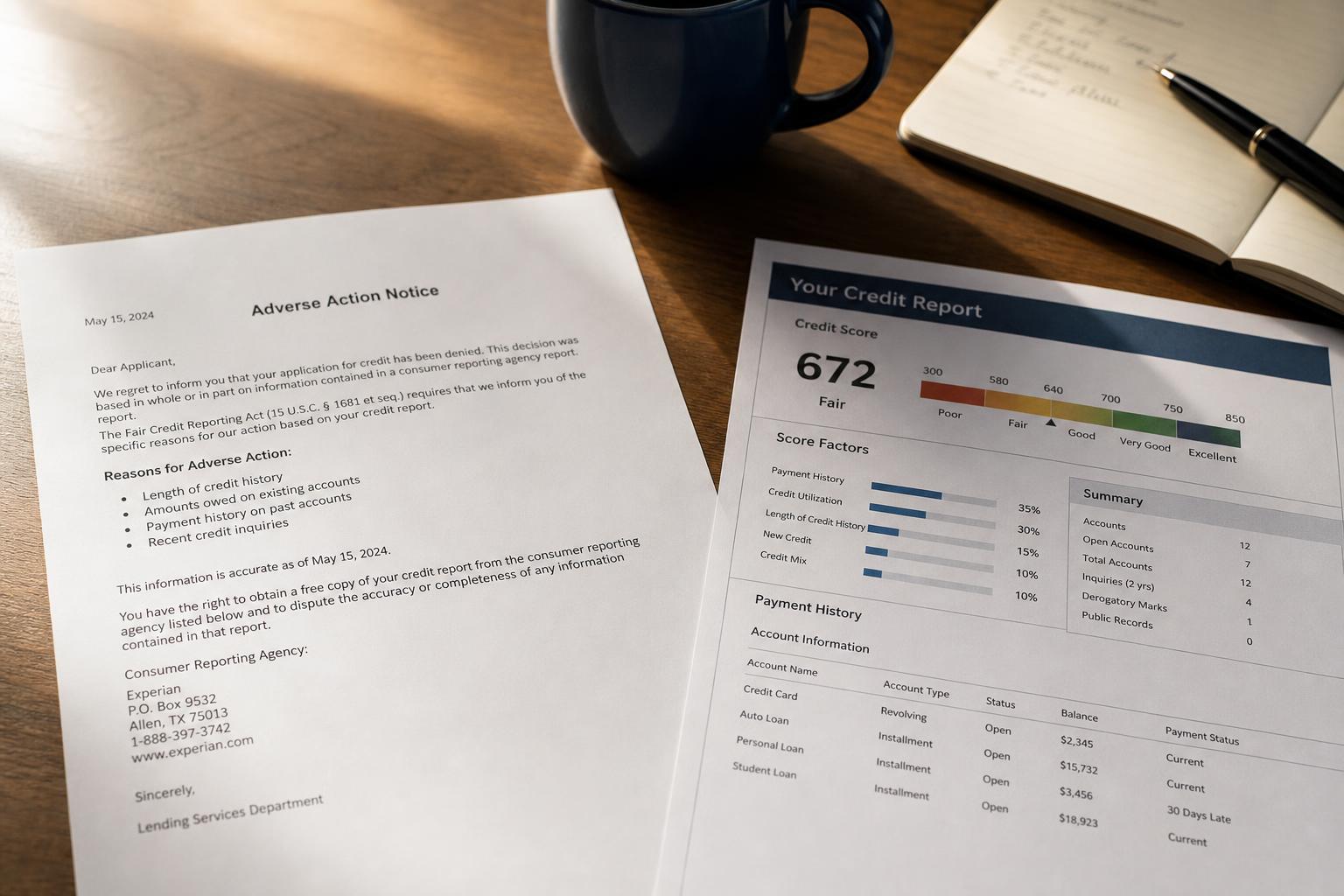
When you’re denied credit, the lender must send an adverse action notice — required under the Equal Credit Opportunity Act and the Fair Credit Reporting Act — stating the main reasons and which credit report they used. This document is your starting point: it tells you, in the lender’s own words, what to address. If you didn’t get one, ask.
Credit reasons
The most common cause is something in your credit: a score below the lender’s cutoff, high utilization, recent late payments or collections, or too many recent hard inquiries. Pull your report and look for whichever of these the notice flagged — and check for errors while you’re there.
Income and debt-to-income reasons
Credit isn’t everything. Lenders also weigh whether you can afford the payment, measured largely by your debt-to-income (DTI) ratio — your monthly debt payments versus your income. If your DTI is high or your income is too low for the amount requested, you can be declined even with decent credit. Asking for a smaller loan sometimes changes the answer.
A too-new or thin file
Sometimes the problem is too little history rather than bad history. A thin file — few accounts, or a short track record — gives a lender little to judge, which can mean a decline or a higher rate. The fix is to build more history over time.

What to fix before you reapply
Use the notice as a checklist. Pay down balances to lower utilization, get current and stay current, dispute any errors, avoid new applications for a bit, and consider a smaller amount or a co-applicant if income was the issue. Give the changes a couple of reporting cycles to show up before trying again — reapplying immediately usually just adds another inquiry.
Pre-qualify with a soft pull next time
Before formally applying again, use pre-qualification, which typically uses a soft pull and shows whether you’re likely to be approved — without the hard inquiry of a full application. It’s the low-risk way to shop; here’s the difference between prequalifying and applying.
Key takeaways
- Your adverse-action notice names the reasons and the report used — start there.
- Common credit reasons: a low score, high utilization, recent lates, or too many inquiries.
- Income and a high debt-to-income ratio can cause a denial even with okay credit.
- A thin or too-new file gives lenders little to judge — build history over time.
- Fix the flagged issues, wait a cycle or two, and pre-qualify with a soft pull before reapplying.
Denied and not sure what to fix first?
A free 15-minute review reads your credit report against the denial reasons and helps you see what to address before you reapply. No obligation.
Free · about 15 minutes · no credit card · no obligation.
Sources: Equal Credit Opportunity Act (ECOA) and Fair Credit Reporting Act (FCRA) — adverse-action notice requirements; Consumer Financial Protection Bureau (CFPB) — why loan applications are denied and what to do. Lender criteria vary; this is general education, not financial advice.