

What Credit Score Do You Need for a Car Loan?
There’s no magic number to finance a car — but your score decides which “tier” you land in, and that can mean thousands of dollars.
You can get a car loan across a wide range of credit scores. The real question isn’t usually whether you’ll be approved — it’s at what interest rate, because that’s where your score quietly costs or saves you a fortune.
Here’s how auto lenders sort applicants into tiers, and how to land in a better one before you walk onto the lot.
Credit tiers: how auto lenders sort you
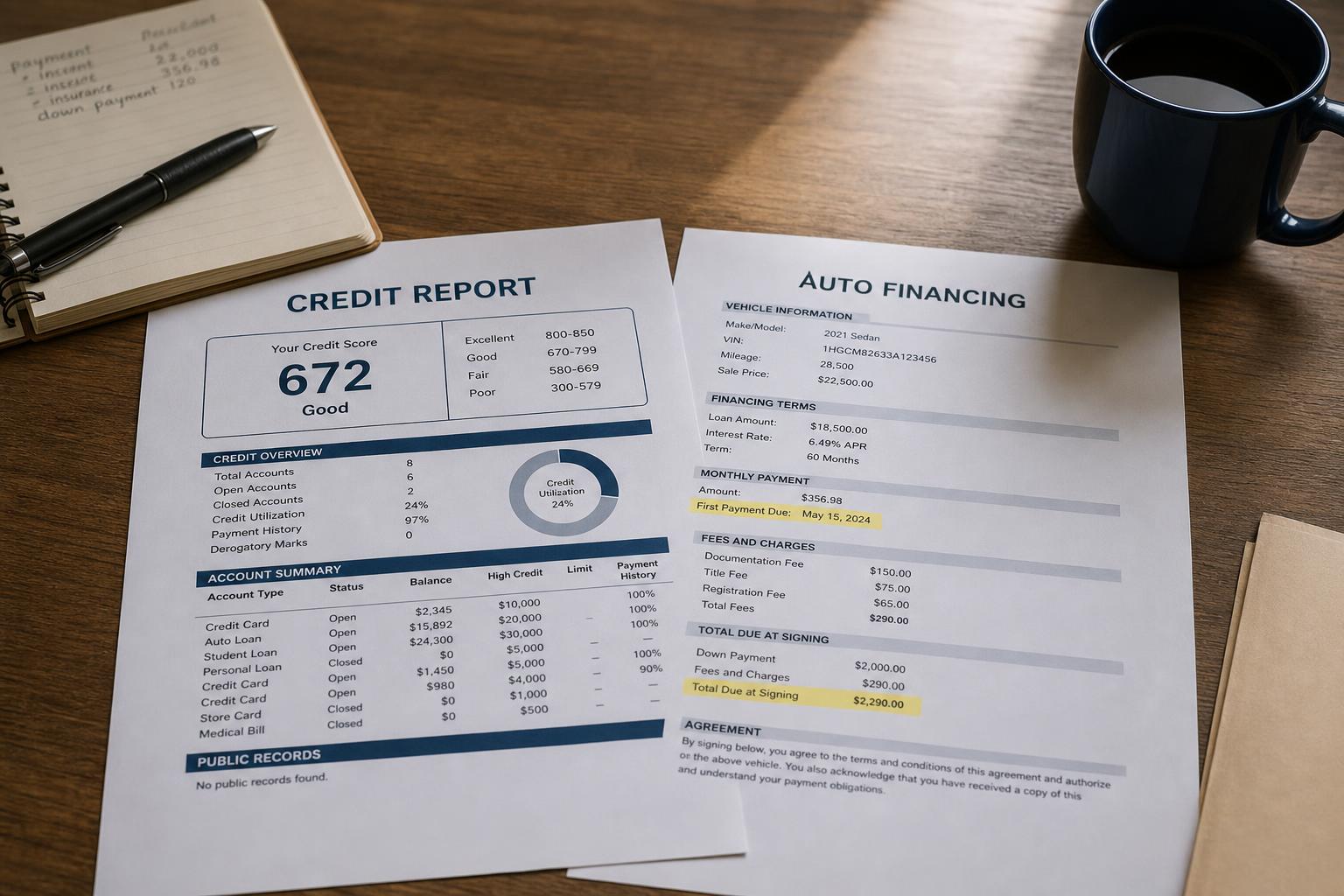
Auto lenders group borrowers into credit tiers, and your tier sets the rate you’re offered. Lenders often use a specialized auto score that weighs your history of repaying car loans, but it tracks closely with your regular credit score. The industry generally talks in these bands:
- Superprime — 781–850: the best rates.
- Prime — 661–780: strong, competitive rates.
- Nonprime — 601–660: approvable, but higher rates.
- Subprime — 501–600: limited options, steep rates.
- Deep subprime — 300–500: hardest, most expensive.
What the tiers mean for approval
Notice that even the lowest tier can often get financed — subprime lending is a large market. So a denial isn’t the only risk; the bigger one is an approval at a punishing rate. Knowing your tier before you shop tells you whether to expect a clean offer or to brace for markup — and whether it’s worth nudging your score up first.
How your score affects your rate (the real cost)
The gap between tiers is not small. The difference between a prime and a subprime auto rate can run many percentage points, which on a multi-year loan can add thousands of dollars to what you pay for the same car. Two people can buy identical vehicles and pay wildly different totals purely because of their tier. That’s why the score — not just the approval — is worth attention.
Buying with bad credit (and the buy-here-pay-here trap)
If your credit is rough, be especially careful with buy-here-pay-here (BHPH) and “no credit check” lots. They approve almost anyone, but the trade-offs are real: very high interest, older vehicles, and — critically — many don’t report your payments to the credit bureaus, so paying faithfully may build no credit at all. We break down the true cost in no credit check car lots: the real cost.
Improve your tier before you shop
Small moves can bump you into a better band before you finance:
- Lower your card balances to cut utilization — one of the more responsive levers.
- Make every payment on time in the months before you apply.
- Fix errors on your report so an inaccuracy isn’t dragging your tier down.
- Save a larger down payment to shrink the loan and offset risk.
None of this is a guarantee, but moving up even one tier can change your rate meaningfully.
Get pre-qualified with a soft pull
Before you sit at a dealer’s finance desk, get pre-qualified with your own bank or credit union. Pre-qualification typically uses a soft inquiry (no score impact — see soft vs. hard inquiries), shows you the rate you actually qualify for, and gives you a benchmark to negotiate against. And when you do formally shop, cluster your applications into a short window so the hard inquiries count as one.
Key takeaways
- There’s no fixed minimum score for a car loan — your score sets your tier and your rate.
- Common tiers: superprime 781+, prime 661–780, nonprime 601–660, subprime 501–600, deep subprime below.
- The rate gap between tiers can add thousands over the life of the loan.
- Watch buy-here-pay-here lots: high rates, and many don’t report payments to the bureaus.
- Lower utilization, pay on time, fix errors, then get pre-qualified with a soft pull before the lot.
Know your tier before the dealer does
A free 15-minute review shows what’s on your credit report and what may be affecting the rate you’d be offered — so you can shop from a position of strength.
Free · about 15 minutes · no credit card · no obligation.
Sources: Consumer Financial Protection Bureau (CFPB) — auto loans, rate shopping, and financing; Experian — the standard auto credit-tier bands (superprime through deep subprime). Tier cutoffs and rates vary by lender, score model, and market; this is general education, not financial advice.