
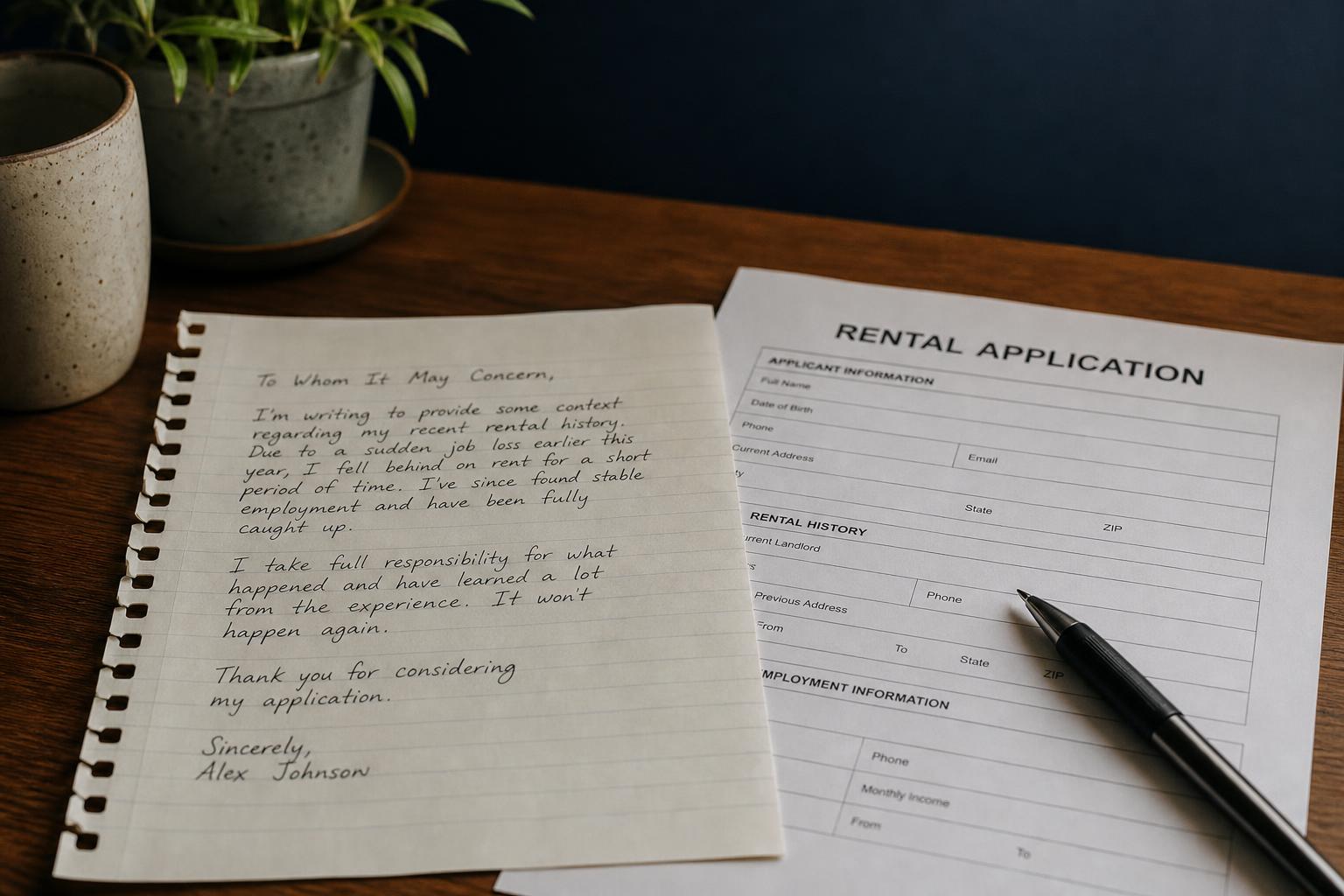
How to Write a Letter of Explanation for a Rental Application
When your application has a blemish, a short, honest letter can do what a credit score can’t — give a landlord a reason to say yes.
Credit reports and screening tools don’t tell your story. A letter of explanation does — it’s your chance to add the context behind a low score, a past eviction, or a gap, and to show what’s changed.
Used well, it can tip a borderline application in your favor. Here’s how to write one.
When a letter of explanation helps
A letter is most useful when there’s a specific, explainable issue on your application: a stretch of late payments during a job loss or medical event, an old eviction you’ve since moved past, a thin credit file, or income that comes from a less traditional source. It works best with flexible landlords who read applications individually — the kind discussed in second chance apartments.
What landlords actually want to see
A landlord’s real question is simple: will this person pay rent and be a good tenant? Your letter should answer it. They want to see that you take the concern seriously, that the cause was specific (not a pattern), that it’s resolved or improving, and that you have a plan. Honesty and brevity beat excuses.
A simple structure that works
Keep it to one page, and follow a clear arc:
- Situation — briefly name the issue the landlord will see.
- Context — what caused it, without over-explaining.
- What changed — how it’s resolved or how you’ve stabilized since.
- Reassurance — why you’ll be a reliable tenant now (income, references, deposit).
A sample outline
You don’t need fancy language. A workable version reads like: “I want to address the late payments on my credit report from 2023. During that time I was out of work after a layoff. I’ve since been steadily employed for 18 months (pay stubs attached), I’m current on all accounts, and I can provide references from my last two landlords. I’m confident I’ll be a reliable tenant and am happy to discuss.” Specific, calm, forward-looking.

What to attach
Back the letter with proof: recent pay stubs or an offer letter, bank statements, references from prior landlords, and anything that documents a resolved issue (a payoff letter, a court record showing a case was dismissed). Evidence turns a claim into a credible case.
What not to do
Don’t write a novel, don’t blame others, and don’t lie — landlords verify. Don’t volunteer unrelated problems, and don’t sound defensive. If a denial is already in motion for credit reasons, pair the letter with the steps in appealing or reapplying after a denial.
Key takeaways
- A letter of explanation adds the context a credit score can’t — best with flexible landlords.
- Answer the landlord’s real question: will you pay rent and be a good tenant?
- Structure it: situation, context, what changed, reassurance — one page.
- Attach proof: pay stubs, references, and documents showing a resolved issue.
- Be honest and brief; don’t blame, exaggerate, or volunteer unrelated problems.
Know what your application will show first
A free 15-minute review walks through what’s on your credit report — so you can explain it accurately and apply prepared, not guessing.
Free · about 15 minutes · no credit card · no obligation.
Sources: Consumer Financial Protection Bureau (CFPB) — tenant-screening and renter rights; U.S. Department of Housing and Urban Development (HUD) — fair-housing guidance. Landlord practices vary; this is general education, not legal advice.